Showing posts with label Radiation. Show all posts

Sunday, April 10, 2011

Japan to pump radioactive water into sea until Sunday

Japan to pump radioactive water into sea until Sunday

Shinichi Saoshiro and Yoko Kubota,
Reuters
April 9, 2011

Japan will pump radioactive water into the sea from a crippled nuclear plant until Sunday, a day later than previously planned, its nuclear safety agency said.

The announcement came a day after China expressed concern at the discharge of contaminated water from the Fukushima Daiichi plant smashed by last month’s earthquake, reflecting growing international unease over the month-long nuclear crisis.

“We are working on releasing water … we are likely to finish this tomorrow,” Hidehiko Nishiyama, a deputy director- general at Japan’s Nuclear and Industrial Safety Agency, told reporters today.

Plant operator Tokyo Electric Power Co (TEPCO) said earlier it expected to stop pumping tainted water into the sea on Saturday, but work was interrupted by a powerful aftershock on Thursday.

Full article here 

Video- Inside report from Fukushima nuclear reactor evacuation zone

Video- Inside report from Fukushima nuclear reactor evacuation zone


YouTube
April 8, 2011

Fukushima, Japan – The Japanese government has issued the evacuation order on March 12 for the residents living within the 20 kilometer radius of the Fukushima Daiichi Nuclear Power Plant.

Since then, residents have left their homes, and the “no man land” has been out of touch with the rest of the world.

A Japanese journalist, Tetsuo Jimbo, ventured through the evacuation zone last Sunday, and filed the following video report.

He says that, inside the evacuation zone, homes,building, roads and bridges, which were torn down by Tsunami, are left completely untouched, and the herd of cattle and pet dogs, left behind by the owners, wonders around the town while the radiation level remains far beyond legal limits.

Watch the video report.

Saturday, April 2, 2011

Fukushima Fallout Reaches U.S.A.

Fukushima Fallout Reaches U.S.A.

Mike Whitney
Infowars.com
April 1, 2011

Three of the six nuclear reactors at Fukushima Daiichi nuclear plant have partially melted down and highly toxic plutonium is seeping into the soil outside. Plutonium is less volatile than other radioactive elements like iodine or cesium, but it’s also more deadly. According to Businessweek, “When plutonium decays, it emits what is known as an alpha particle, a relatively big particle that carries a lot of energy. When an alpha particle hits body tissue, it can damage the DNA of a cell and lead to a cancer-causing mutation.” If plutonium leaches into groundwater or pristine aquifers, the threat to public health and the environment will be extreme. This is an excerpt from an article in the Guardian:

“The radioactive core in a reactor at the crippled Fukushima nuclear power plant appears to have melted through the bottom of its containment vessel and on to a concrete floor, experts say, raising fears of a major release of radiation at the site. The warning follows an analysis by a leading US expert of radiation levels at the plant….


Richard Lahey, who was head of safety research for boiling-water reactors at General Electric when the company installed the units at Fukushima, told the Guardian workers at the site appeared to have “lost the race” to save the reactor…” (“Japan may have lost race to save nuclear reactor”, The Guardian)
It also appears that underground tunnels at the facility have been flooded with radioactive water that contains high-concentrations of caesium-137. A considerable amount of the water has made its way to the sea where samples show the levels of contamination steadily rising. This is from the Wall Street Journal:

“Levels of radiation in the ocean next to the Fukushima Daiichi nuclear power plant have surged to record highs, the government said Wednesday, as operators try to deal with large amounts of radioactive water—the unwanted byproduct of operations to cool the reactors.

The Nuclear and Industrial Safety Agency said water taken Tuesday afternoon from the monitoring location for the troubled reactors Nos. 1 to 4 had 3,355 times the permitted concentration of iodine-131. That is the highest yet recorded at the sampling location, which is 330 meters south of the reactors’ discharge outlet.” (“Seawater Radiation Level Soars Near Plant”, Wall Street Journal) All fishing has been banned in the vicinity as the toxins pose a danger to human health.

The Japanese government’s chief spokesman, Yukio Edano, issued a public statement admitting that the situation at Fukushima is progressively getting worse with no end in sight. “We are not yet in a situation where we can say when we will have this under control,” said Edano. In other words, the emergency effort is failing.

The fact that Japan is experiencing the biggest environmental catastrophe in history explains why the media has been trying so hard to divert the public’s attention to Obama’s military adventure in Libya. But it hasn’t worked; all eyes are locked on Fukushima where the crisis continues to get more precarious by the day. News anchors assure their viewers that they are only being exposed to “safe levels of radioactivity”, but people aren’t buying it. They’ve seen the comparisons to Chernobyl and made their own judgements. Here’s an excerpt from an article in Counterpunch by Chris Busby that gives a thumbnail sketch of the human costs of the meltdown at Chernobyl:

“The health effects of the Chernobyl accident are massive and demonstrable.

They have been studied by many research groups in Russia, Belarus and the Ukraine, in the USA, Greece, Germany, Sweden, Switzerland and Japan. The scientific peer reviewed literature is enormous. Hundreds of papers report the effects, increases in cancer and a range of other diseases. My colleague Alexey Yablokov of the Russian Academy of Sciences, published a review of these studies in the Annals of the New York Academy of Sciences (2009). Earlier in 2006 he and I collected together reviews of the Russian literature by a group of eminent radiation scientists and published these in the book Chernobyl, 20 Years After. The result: more than a million people have died between 1986 and 2004 as a direct result of Chernobyl.” (“Deconstructing Nuclear Experts, Chris Busby, Counterpunch)

One million dead, that’s the bottom line. And, according to Busby, “we can already calculate that the contamination (at Fukushima) is actually worse than Chernobyl.”

That’s certain, but don’t expect to read it in the MSM. Or this, which is also from Busby:

Since the official International Atomic Energy Agency (IAEA) figures for the Fukushima contamination are from 200 to 900kBq.sq metre out to 78km from the site, we can expect between 22% and 90% increases in cancer in people living in these places in the next 10 years.”

There’s a large body of research on the effects of radiation on humans. In fact, scientists conducted a series of studies on the people living on the Marshall Islands following nuclear weapons tests at Bikini and Enewetak atolls. This is where the US exploded more than 60 atomic bombs between 1946-58. Here’s an excerpt from an article in Counterpunch titled “Radiation, Japan and the Marshall Islands; Living and dying downwind”:

"The legacy of latent radiogenic diseases from hydrogen bomb testing in the Marshall Islands provides some clues about what ill-health mysteries await the affected Japanese in the decades ahead…..Traces of I-131 have been discovered in Tokyo drinking water and in seawater offshore from the reactors. It took nine years for the first thyroid tumor to appear among the exposed Marshallese and hypothyroidism and cancer continued to appear decades later……


o Plutonium-239 has a half life of 24,000 years, is considered one of the most toxic substances on Earth, and if absorbed is a potent alpha emitter that can induce cancer. This isotope too is found in the soils and groundwater of the downwind atolls from the Bikini and Enewetak H-bomb tests…

Radioactive Iodine-129 with a half-life of 15 million years and a well-documented capacity to bioaccumulate in the foodchain, will also remain as a persistent problem for the affected Japanese…

The sociocultural and psychological effects [e.g., PTSD] of the Fukushima nuclear disaster will be long-lasting, given the uncertainty surrounding the contamination of their prefecture and beyond.” (“Radiation, Japan and the Marshall Islands; Living and dying downwind”, Glenn Alcalay, Counterpunch)

It’s all bad, which is why the nuclear industry needs stooges in the media to soft-peddle the news. Because, in truth, what they’re selling is a noxious stew of irradiated poison that kills and maims people while causing incalculable damage to the environment. That’s why industry bigwigs have turned to their friends at the EPA to loosen regulations so that the radioactive material that’s presently showering-down on the US falls within EPA safety standards. Here’s a clip from Washington’s Blog that explains what’s going on behind the public’s back:

“….the EPA is considering drastically raising the amount of allowable radiation in food, water and the environment.

As Michael Kane writes:

In the wake of the continuing nuclear tragedy in Japan, the United States government is still moving quickly to increase the amounts of radiation the population can “safely” absorb by raising the safe zone for exposure to levels designed to protect the government and nuclear industry more than human life. It’s all about cutting costs now as the infinite-growth paradigm sputters and moves towards extinction. As has been demonstrated by government conduct in the Gulf of Mexico in the wake of Deepwater Horizon and in Japan, life has taken a back seat to cost-cutting and public relations posturing. The game plan now appears to be to protect government and the nuclear industry from “excessive costs”… at any cost.” (Washington’s Blog)

The radioactive toxins that are now oozing into the soil and water-table or flowing into Japan’s coastal waters or lofting skyward into the jet-stream where they will spread across continents, will continue to wreak havoc long after this generation has passed its mortal coil. Easing EPA safety standards won’t change a thing. Where goes radiation, there too goes cancer and death. The disaster in Japan merely buys a little time for us to rethink our own policies before a similar crisis strikes here. And, it will strike here; it’s only a matter of time. Consider the comments of Dave Lochbaum, Director of UCS’s Nuclear Safety Project, who testified on Wednesday before the Senate Energy and Water Development Appropriations Subcommittee. Here’s what he said:

“Today, tens of thousands of tons of irradiated fuel sits in spent fuel pools across America. At many sites, there is nearly ten times as much irradiated fuel in the spent fuel pools as in the reactor cores. The spent fuel pools are not cooled by an array of highly reliable emergency cooling systems capable of being powered from the grid, diesel generators, or batteries. Instead, the pools are cooled by one regular system sometimes backed up by an alternate makeup system.

The spent fuel pools are not housed within robust concrete containment structures designed to protect the public from the radioactivity released from damaged irradiated fuel. Instead, the pools are often housed in buildings with sheet metal siding like that in a Sears storage shed. I have nothing against the quality or utility of Sears’ storage sheds, but they are not suitable for nuclear waste storage.


The irrefutable bottom line is that we have utterly failed to properly manage the risk from irradiated fuel stored at our nation’s nuclear power plants. We can and must do better.” (The Union of Concerned Scientists)

Nuclear energy is a ticking-timebomb. There are safer ways to keep the lights on.

Read Mike Whitney’s blog. 

Thursday, March 31, 2011

Videos- A New Chernobyl: Fukushima Nuke Plant Now in Full Meltdown

Videos- A New Chernobyl: Fukushima Nuke Plant Now in Full Meltdown

Kurt Nimmo
Infowars.com
March 30, 2011

Reactor number two at the Fukushima Daiichi has gone into full meltdown, although this is not being reported by the corporate media. The core has melted through the floor of the containment building and is now releasing large amounts of radiation.


Richard Lahey, who was head of safety research for boiling-water reactors at General Electric when the company installed the units at Fukushima, told the Guardian on Tuesday workers at the site appeared to have “lost the race” to save the reactor.

“The indications we have, from the reactor to radiation readings and the materials they are seeing, suggest that the core has melted through the bottom of the pressure vessel in unit two, and at least some of it is down on the floor of the drywell,” Lahey said. “I hope I am wrong, but that is certainly what the evidence is pointing towards.”

On March 12, the Japanese government assured its citizens there was no possiblity of a nuclear meltdown. Five days later, Japan’s nuclear agency raised tbe severity rating of the nuclear crisis from a Level 4 to Level 5 on a seven-level international scale.

On March 29, Japanese Prime Minister Naoto Kan said his government is in a state of maximum alert over high-level radiation leaked from the plant.
Also on Tuesday, it was reported that deadly plutonium had leaked from reactor number two. Japan’s Nuclear and Industrial Safety Agency insisted the leak was not harmful to human life.


Sakae Muto, Tokyo Electric vice-president, said the amount of plutonium-238, 239 and 240 released into the atmosphere was on par with past nuclear tests. “I apologize for making people worried,” he said.

Record-high readings of contaminated sea water were found near the plant, Bloombergreports. Radioactive iodine in seawater rose to 3,355 times the regulated safety limit yesterday afternoon from 2,572 times earlier in the day, agency spokesman Hidehiko Nishiyama said. Nishiyama said the radiation is not a threat because there is no fishing in the area.

Experts say a reactor in meltdown will stop at or before the underlying soil of the containment structure, but will release massive amount of radiation into the atmosphere and ground causing extensive damage to plant and animal life. This process is now underway at the Fukushima Daiichi plant.

Meanwhile, there appears to be problems with a second nuclear plant. Tokyo Electric Power Co. said smoke was reported coming from the turbine building of reactor No. 1 at the Fukushima Daini nuclear power plant earlier today. The Fukushima Daini nuclear power plant is about 6 miles from the Fukushima Daiichi nuclear power plant.

Wednesday, March 30, 2011

Videos- Fukushima Nuke Plant Now in Full Meltdown

Videos- Fukushima Nuke Plant Now in Full Meltdown

Kurt Nimmo
Infowars.com
March 30, 2011

Reactor number two at the Fukushima Daiichi has gone into full meltdown, although this is not being reported by the corporate media. The core has melted through the floor of the containment building and is now releasing large amounts of radiation.


Richard Lahey, who was head of safety research for boiling-water reactors at General Electric when the company installed the units at Fukushima, told the Guardian on Tuesday workers at the site appeared to have “lost the race” to save the reactor.

“The indications we have, from the reactor to radiation readings and the materials they are seeing, suggest that the core has melted through the bottom of the pressure vessel in unit two, and at least some of it is down on the floor of the drywell,” Lahey said. “I hope I am wrong, but that is certainly what the evidence is pointing towards.”

On March 12, the Japanese government assured its citizens there was no possiblity of a nuclear meltdown. Five days later, Japan’s nuclear agency raised tbe severity rating of the nuclear crisis from a Level 4 to Level 5 on a seven-level international scale.

On March 29, Japanese Prime Minister Naoto Kan said his government is in a state of maximum alert over high-level radiation leaked from the plant.

Also on Tuesday, it was reported that deadly plutonium had leaked from reactor number two. Japan’s Nuclear and Industrial Safety Agency insisted the leak was not harmful to human life.


Sakae Muto, Tokyo Electric vice-president, said the amount of plutonium-238, 239 and 240 released into the atmosphere was on par with past nuclear tests. “I apologize for making people worried,” he said.

Record-high readings of contaminated sea water were found near the plant, Bloomberg reports. Radioactive iodine in seawater rose to 3,355 times the regulated safety limit yesterday afternoon from 2,572 times earlier in the day, agency spokesman Hidehiko Nishiyama said. Nishiyama said the radiation is not a threat because there is no fishing in the area.

Experts say a reactor in meltdown will stop at or before the underlying soil of the containment structure, but will release massive amount of radiation into the atmosphere and ground causing extensive damage to plant and animal life. This process is now underway at the Fukushima Daiichi plant.


Meanwhile, there appears to be problems with a second nuclear plant. Tokyo Electric Power Co. said smoke was reported coming from the turbine building of reactor No. 1 at the Fukushima Daini nuclear power plant earlier today. The Fukushima Daini nuclear power plant is about 6 miles from the Fukushima Daiichi nuclear power plant.

Tuesday, March 29, 2011

EPA to Help Mainstream Media Obscure The Truth About Radiation Exposure to Americans

EPA to Help Mainstream Media Obscure The Truth About Radiation Exposure to Americans


Brandon Turbeville
Activist Post
March 29, 2011

As Americans focus on March Madness and Dancing With the Stars instead of the radioactive plume spreading all across the country, the US EPA (Environmental Protection Agency) is attempting to make the mainstream media cover up of the Fukushima cloud a bit easier.

The agency now notorious for its infamous claim that the air was safe to breathe after 9/11 is now seeking to raise the PAGs (Protective Action Guides) to levels vastly higher than those at which they are currently set allowing for more radioactive contamination of the environment and the general public in the event of a radioactive disaster.

PAGs are policies established by the EPA that guide the agency in enforcing the various environmental laws such as the Clean Air and Water Act in the invent of a radioactive emergency such as a nuclear/dirty bomb or factory meltdown like that occurring in Japan.

The EPA had already established PAGs in this area in 1992. They can be found here. However, the agency now plans to amend and revise these standards this year.

Because regulatory agencies form their own policies (although they can be directed by either the President or the Congress), there is no requirement to seek Congressional approval for these changes. All that is required is that the agency place the proposed changes in the Federal Register for public comment before it finalizes its draft into legal policy.

Read the rest of the article.

Monday, March 28, 2011

Radiation detected in Massachusetts rainwater as Fukushima crisis worsens

Radiation detected in Massachusetts rainwater as Fukushima crisis worsens

Mike Adams,
Natural News
March 28, 2011

The Fukushima crisis continues to worsen by the day, with nuclear experts around the world finally realizing and admitting we’ve all been lied to. “I think maybe the situation is much more serious than we were led to believe,” said Najmedin Meshkati of the University of Southern California, in a Reuters report (http://www.reuters.com/article/2011…). That same article revealed that recent radiation readings at Fukushima show “contamination 100,000 times normal in water at reactor No. 2 and 1,850 times normal in the nearby sea.”

Massachusetts rainwater has also been found to be contaminated with low levels of radiation from Fukushima, indicating just how widespread the radioactive fallout has become. It’s not just the West Coast of North America that’s vulnerable, in other words: even the East Coast could receive dangerous levels of fallout if Fukushima suffers a larger release of radioactive material into the air.

Rolling blackouts are now continuing throughout Japan due to the drop in power production from Fukushima diminishing Japan’s electricity generating capacity (http://english.kyodonews.jp/news/20…). The only reason Japan isn’t experiencingwidespread power blackoutsright now is because so many factories were damaged or swept away from the tsunami itself. Once a serious rebuilding effort gets underway, Japan is going to find itself critically short of electrical power.

The radiation leaking from Reactor No. 2 is now measured at1,000 millisieverts an hour– more than enough to cause someone’s hair to fall out from a single exposure event. Radiation sickness can begin at just 100 millisieverts. The extremely high levels of radiation are, in fact, making it nearly impossible for workers to continue working at the reactor. “You’d have a lot of difficulty putting anyone in there,” said Richard Wakeford, a radiation epidemiology expert at the Dalton Nuclear Institute in Manchester. “They’re finding quite high levels of radiation fields, which is impeding their progress dealing with the situation.” (http://www.businessweek.com/news/20…)

The worsening Fukushima situation is also starting to spook nearby nations such as Taiwan, which also depends on nuclear power. The DPP opposition party there announced today that it wanted to see nuclear power phased out by 2025. Taiwan is a relatively small island nation, and a Fukushima-like catastrophe would leave most of the island residents with nowhere to go. And like Japan, Taiwan is also vulnerable to earthquakes and tsunamis (as well as hurricanes).

In Germany, massive demonstrations (200,000 people in four large cities) have brought the nuclear safety issue to the forefront, contributing heavily to the defeat of Merkel and the rise to power of theGreen Partyin southwestern Germany (http://www.nytimes.com/2011/03/28/w…). Germans tend to have very strong opposition to nuclear power, in much the same way that most Europeans despise genetically modified foods.

The nuclear powerindustryturns out to be just as corrupt asBig Pharma

The truth is thatmany nations are rethinking nuclear power right now, thanks to the corruption, cover-ups and outright deceptions that we’re now finding out were behind the Fukushima power plant catastrophe. The nuclear industry, it turns out, is one bigprofit incest festwhere the regulatorsare deeply in bed with the very industry they’re supposed to regulate (http://online.wsj.com/article/SB100…).

Then again, what rich, powerful industryisn’tin bed with its regulators? It’s true with Big Pharma and the FDA just as much as it is with the nuclear power industry and its corrupt regulators.Every government-run regulator eventually becomes a marketing extension of the industry it was supposed to regulate.

That’s why Big Government never really works: Most of the regulators who are supposed to protect the people inevitably end up operating as industry whores. This entire Fukushima incident is a direct result of that deep-rooted corruption coming back to haunt humanity.

Watch for more reporting on this incident here at NaturalNews.com, and subscribe to our daily email alerts to be kept up to date on the situation:http://www.naturalnews.com/ReaderRe…

The Fukushima situation is nowhere near over. Now regulators are saying this might take not justweeksormonthsto sort out, but evenyearsto fully rectify.

The half life ofplutonium, it turns out, is a whole lot longer than the entire history of human civilization (24,000 years) (http://en.wikipedia.org/wiki/Plutonium). We would be wise to remember what we’re playing with when we attempt to harness the power of fission.

Gov’t asks treatment plants not to take in rainwater due to radiation

Gov’t asks treatment plants not to take in rainwater due to radiation

Kyodo
March 28, 2011


The health ministry has instructed the operator of water purification plants nationwide to temporarily stop taking in rainwater to prevent contamination in tap water following radiation leaks from the crippled Fukushima Daiichi nuclear plant, ministry officials said Sunday.

While calling on the plants to ensure stable supply of tap water, the Ministry of Health, Labor and Welfare also proposed covering pools of the plants with tarps to keep out rainwater or to use powdered activated carbon that can help get rid of radioactive materials.

The instruction by the ministry came after radiation levels beyond Japan’s regulated standard were found in tap water at multiple purification plants in Fukushima and other prefectures including Tokyo, 220 kilometers southwest of the plant.

Radioactive materials emitted to the atmosphere from the nuclear plant apparently fell down to earth with the rain. Radiation levels in water fall over time after it stops raining.

Read the rest of the article.

Video- New Highs For Radiation Levels In Japan

Video- New Highs For Radiation Levels In Japan

Video- Radiation Detected In 12 U.S. States

Video- Radiation Detected In 12 U.S. States


Sunday, March 27, 2011

Video- Worst Case Is Radioactive Lava On Japan Beaches

Video- Worst Case Is Radioactive Lava On Japan Beaches

Video- 10,000,000 times normal radiation spike at Fukushima 'mistake' - officials

Video- 10,000,000 times normal radiation spike at Fukushima 'mistake' - officials


Weather Models Show High Levels of Radiation Entering U.S. from Japan

Weather Models Show High Levels of Radiation Entering U.S. from Japan


Kurt Nimmo
Infowars.com
March 27, 2011

On Saturday, Yukiya Amano, the director of the United Nations’ International Atomic Energy Agency, said the Japanese nuclear crisis could go on for weeks, if not for months.

Weather Models Show High Levels of Radiation Entering U.S. from Japan  levels2
Test conducted Friday showed iodine 131 levels in seawater 30 km (19 miles) from the coastal Fukushima Daiichi nuclear plant had spiked 1,250 times higher than normal. Japanese officialdom insisted this unusual level does not pose a threat to marine life or food safety, according toReuters.

“Ocean currents will disperse radiation particles and so it will be very diluted by the time it gets consumed by fish and seaweed,” said Hidehiko Nishiyama, a senior agency official.

A number of countries have banned milk and produce from areas around the Fukushima Daiichi plant, while others have been monitoring Japanese seafood.

Amano told the media the Japanese have no idea if the reactor cores and spent fuel were covered with the water needed to cool them and prevent the release of radiation. “More efforts should be done to put an end to the accident,” he said and was carefully not to criticize Japan’s lackadaisical response.

An official from plant operator Tokyo Electric Power Co (TEPCO) told a Sunday news conference experts still are not certain where to put the contaminated water.

Scientists quoted by the corporate media continue to insist that radioactive particles crossing the Pacific are far too diluted to cause any harm.

In fact, scientists are complaining that the Japanese have not fowarded sufficient information on the nuclear meltdown. They say the quality and quantity of information coming out of Japan has left gaping holes in their understanding of the disaster nearly two weeks after it began.

Independent researchers, however, dispute claims that the radiation now lofting over the northern hemisphere is not dangerous. The Weather Online website has posted a number animated models showing dangerous concentrations of iodine 131 and caesium 137 entering the United States with prevailing weather and the jet stream.

The site notes that since the continuous release rate is very uncertain, the calculations have to be interpreted qualitatively.

Here is a video posted earlier today showing the animations:


Addendum

“An international advisory body has recommended the Japanese government temporarily raise the annual limit of radiation exposure for the general public in light of the ongoing crisis at the quake- and tsunami-crippled nuclear power plant in Fukushima Prefecture,” reportsThe Mainichi Daily News.

“The government stipulates that regular citizens in Japan should be exposed to no more than 1 millisievert of radiation per year, but the International Commission on Radiological Protection (ICRP) on March 21 recommended the limit be tentatively raised to 20 to 100 millisieverts per year, with the nuclear crisis showing no signs of abating.”

The NGO said the level of permissible radiation should be increased “in order to prevent residents of Fukushima Prefecture from abandoning their hometowns.”

Officials retract reports of extremely high radiation at Fukushima plant

Officials retract reports of extremely high radiation at Fukushima plant

Comment: Yet more evidence suggesting that the Japanese government is covering up the extent of a crisis they cannot effectively manage.

Julie Makinen and Kenji Hall
LA Times
March 27, 2011

Earlier reports said that contamination had reached 10 million times higher than normal. The reversal highlights the sometimes overwhelming cascade of information the Japanese are now receiving about the nuclear crisis.

Officials at Japan’s stricken Fukushima Daiichi nuclear plant late Sunday retracted their announcement that they had found puddles at the facility’s No. 2 reactor containing 10 million times more radioactivity than would be found in water in a normally functioning nuclear reactor.

“The number is not credible,” Tokyo Electric Power Co. spokesman Takashi Kurita, said, according to the Associated Press. “We are very sorry.”

It was not immediately clear what led to the inaccurate reading of the water, or what the real level was.

The initial announcement of the extremely high levels of radioactivity in the turbine building of the No. 2 reactor was made by Japan’s Nuclear and Industrial Safety Agency, citing Tepco as the source of the data. The alarming-sounding disclosure raised questions about the source of the radioactivity and the extent of damage to the plant, as well as the threat to workers trying to stabilize the situation at Fukushima, which was crippled by the March 11 earthquake and tsunami that rocked Japan.

Full article here

Fukushima engineer confesses to participating in criminal coverup, says flawed steel in Reactor 4 has always been a ‘time bomb’

Fukushima engineer confesses to participating in criminal coverup, says flawed steel in Reactor 4 has always been a ‘time bomb’

Ethan A. Huff,
Natural News
March 27, 2011

Just days after the 9.1 mega-earthquake and tsunami hit off the east cost of Japan, a former employee of Hitachi Ltd. (6501) came forward saying that he helped cover up a flawed steel protective vessel that was installed in the Fukushima Dai-Ichi Reactor 4 core in 1974. Mitsuhiko Tanaka toldBloombergthat the defective steel in the $250 million vessel was a very serious “time bomb” just waiting to go off, as it represents the key protective unit for the reactor’s core.

Though Reactor 4 was not running at the time of the quake and tsunami, its cooling pool contains a number of spent fuel rods that require proper cooling in order to prevent a serious meltdown. Earlier this week, reports indicated that the pool is empty, and that it seems to have a crack or hole that is preventing it from being effectively refilled, which could spell disaster for the 130 tons of uranium inside the reactor (http://www.naturalnews.com/031769_f…).

More recent reports say that power has been restored to Reactors 1, 2, and 4, but that crews are still concerned about “inadequate water coverage” over the spent fuel rods in the Reactor 4 cooling pool (http://uk.ibtimes.com/articles/1262…).

Concerning Tanaka’s role in the situation, the former nuclear engineer admits that he directly participated in the coverup to disguise the known safety hazard in the Reactor 4 pressure vessel — a hazard that could have devastating consequences if relief workers cannot get the situation under control in upcoming days.

According to theBloombergreport, a mistake during the final construction process of the vessel caused the steel walls to become warped. Based on regulatory guidelines, the cylinder should have been scrapped, said Tanaka, but because doing so would have potentially bankrupted the company, his bosses asked him to come up with a quick fix — and he complied.

After figuring out a way to reshape the flawed vessel and make it look as though nothing was wrong, Tanaka was awarded a three million yen bonus from Hitachi, which also gave him a certificate honoring his “extraordinary” work.

Years later when asked to participate in a documentary on the Chernobyl disaster, Tanaka says he became convicted over what he had done, and decided to come forward with the truth. When he told the Japanese Trade Ministry about the coverup in 1988, they allegedly refused to do anything about it, saying that because Hitachi had denied the accusations, they must not have been true.

Since the current situation at the Fukushima plant is still unfolding, nobody knows for sure the extent of the damage that will take place, and whether or not Tanaka’s dirty little secret will cause a very serious meltdown. In fact, so little information has been coming out of Japan regarding the situation that the world can only speculate as to what is actually going on, including whether or not all the radioactive water being dumped on the reactors is ending up back in the Pacific Ocean. (http://www.latimes.com/news/nationw…).

Sources for this story include:

http://www.bloomberg.com/news/2011-..

Radiation spreads to China as crisis likely to continue for “a long time”

Radiation spreads to China as crisis likely to continue for “a long time”

Xinhua
March 27, 2011

Low levels of radioactive material iodine-131 were detected Saturday in Heilongjiang Province, north of Beijing, China’s National Nuclear Emergency Coordination Committee said.

The radioactive material was likely to have come from the tsunami-damaged Fukushima nuclear plant in Japan, the agency said.

However, since the radiation level was below one-hundred-thousandth of the average natural background radiation, it did not pose a risk to public health or the environment, and no protective measures were required, the agency said in a statement.

Repair work at the troubled Fukushima nuclear plant has continued into a third week. More countries are beginning to detect tiny amounts of radioactive iodine and cesium in the air that have drifted across oceans from the overheated nuclear reactors in Fukushima, where a tsunami following a 9.0-magnitude earthquake knocked out its crucial cooling system on March 11.

The Austrian capital of Vienna detected very low concentrations of radioactive particles Friday, believed to have come from Fukushima, the Austrian Agency for Health and Food Safety (AGES) said.

The detected radioactive materials were iodine-131 and cesium-137, and the tiny amount would pose no threat to human health, the Austrian agency said.
It was the first time the two radioactive materials were detected in the country since the quake struck Japan.

Sea water samples taken from about 330 meters south of the Fukushima Daiichi nuclear plant on Japan’s east coast showed radioactive iodine 1,250.8 times above legal limit near the drain outlets of the reactors, local media reported Saturday.

The reading was taken on Friday morning, recording the highest radiation level so far from the surveys begun this week, plant owner Tokyo Electric Power Co (TEPCO) said.

Read the rest of the article.

Nearly Half of U.S. EPA’s West Coast Radiation Monitors Might be Out Sick

Nearly Half of U.S. EPA’s West Coast Radiation Monitors Might be Out Sick


Related: Gaps in US radiation monitoring system revealed

Dennis Romero
LA Weekly
March 26, 2011

We’ve been telling you for almost two weeks now that radiation from Japan was headed our way, but not to worry.

We are your friend.

The U.S. Environmental Protection Agency reported this week that trace amounts of the Fukushima nuclear power plant radiation was detected in Orange and Riverside Counties — at levels “hundreds of thousands to millions of times below levels of concern.”

Okay. But here is a concern:


Eight of the EPA’s 18 West Coast monitors might not be working!
The agency announced this week that the gizmos were “undergoing quality review,” according to an EPA statement.

Reassuring.

Full story here.

GoogleEarth Based 3D Map Of Real-Time Radioactivity Distribution In Japan; Projected Global Radioactivity Dispersion

GoogleEarth Based 3D Map Of Real-Time Radioactivity Distribution In Japan; Projected Global Radioactivity Dispersion


Tyler Durden
Zero Hedge
March 26, 2011

Confirming that in a time of instantaneous crowdsourced information distribution and analysis, any attempt by a government to institute an information blackout of any nature is doomed to failure, is the following amazing Google Earth-based 3D interactive map of Geiger readings from Japan. And if that is not enough, the Pachube community has released an extensive selection of crowd-sourced realtime radiation monitoring tools and widgets, focusing on as many Japanese territories as possible. Shortly we are confident all geographical holes will be filled, and every square mile of the affected territories will be mapped out surpassed the government’s “Under Survey” blackout attempts.

Make sure to have the GoogleEarth API set up in advance of checking out the plugin.

GoogleEarth Based 3D Map Of Real Time Radioactivity Distribution In Japan; Projected Global Radioactivity Dispersion  googlemap

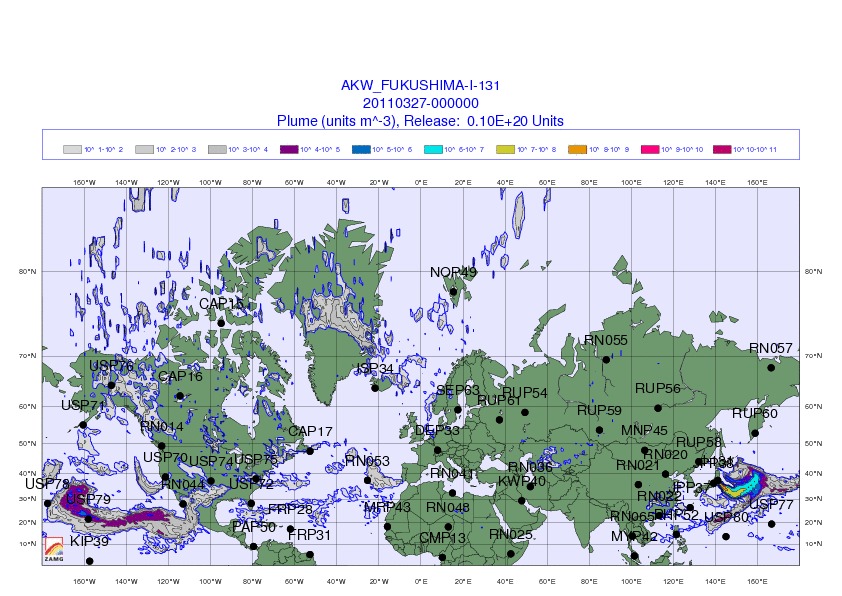
Additionally, here is the most recent updated global radioactive fallout per ZAMG.

GoogleEarth Based 3D Map Of Real Time Radioactivity Distribution In Japan; Projected Global Radioactivity Dispersion  20110325 Reanalyse I131 Bild5 gr

And a complete list of all the available crowdsourced radiation maps, applications and tutorials
h/t Themos Mitsos
 

Radiation 10 Million Times Above Normal Level At Fukushima

Radiation 10 Million Times Above Normal Level At Fukushima


Infowars.com
March 27, 2011

The Tokyo Electric Power Co. (TEPCO) has reported that radiation level in the containment building of reactor number 2 at the stricken Fukushima nuclear power plant is an astounding 10 million times above normal.


Officialdom soon backtracked and said those radiation readings were not accurate and that new tests had been ordered. “The number is not credible,” said TEPCO.

Last week, Japan’s nuclear agency said levels of radioactive iodine in sea near the plant had risen to 1,850 times the usual level. It claims one-half a liter of the water contains the same amount of radiation that a person can safely be exposed to in a year.

The United Nations’ nuclear agency has warned the crisis could go on for months.

It now appears the crisis will go on indefinitely. TEPCO said on Sunday it is not working to resolve the crisis. “We are examining the cause of this, but no work is being done there because of the high level of radiation,” said a TEPCO spokesman. “High levels of caesium and other substances are being detected, which usually should not be found in reactor water. There is a high possibility that fuel rods are being damaged,” he added.

Appearing on Sunday talk shows, cabinet secretary Yukio Edano said radioactive water is “almost certainly” seeping from a reactor core.

Friday, March 25, 2011

Radiation: Nothing to See Here?

Radiation: Nothing to See Here?

Brian Moench, MD
Truthout
Friday, March 25, 2011

Administration spokespeople continuously claim “no threat” from the radiation reaching the US from Japan, just as they did with oil hemorrhaging into the Gulf. Perhaps we should all whistle “Don’t worry, be happy” in unison. A thorough review of the science, however, begs a second opinion.

That the radiation is being released 5,000 miles away isn’t as comforting as it seems. The Japanese reactors hold about 1,000 times more radiation than the bombs dropped over Hiroshima.(1) Every day, the jet stream carries pollution from Asian smoke stacks and dust from the Gobi Desert to our West Coast, contributing 10 to 60 percent of the total pollution breathed by Californians, depending on the time of year. Mercury is probably the second most toxic substance known after plutonium. Half the mercury in the atmosphere over the entire US originates in China. It, too, is 5,000 miles away. A week after a nuclear weapons test in China, iodine 131 could be detected in the thyroid glands of deer in Colorado, although it could not be detected in the air or in nearby vegetation.(2)

The idea that a threshold exists or there is a safe level of radiation for human exposure began unraveling in the 1950s when research showed one pelvic x-ray in a pregnant woman could double the rate of childhood leukemia in an exposed baby.(3) Furthermore, the risk was ten times higher if it occurred in the first three months of pregnancy than near the end. This became the stepping-stone to the understanding that the timing of exposure was even more critical than the dose. The earlier in embryonic development it occurred, the greater the risk.

Read the rest of the article.